 Innovation leads to value

0769 8307 8360

sales@henmey.com

No.53 Chashan Town, Dongguan city, Guangdong province
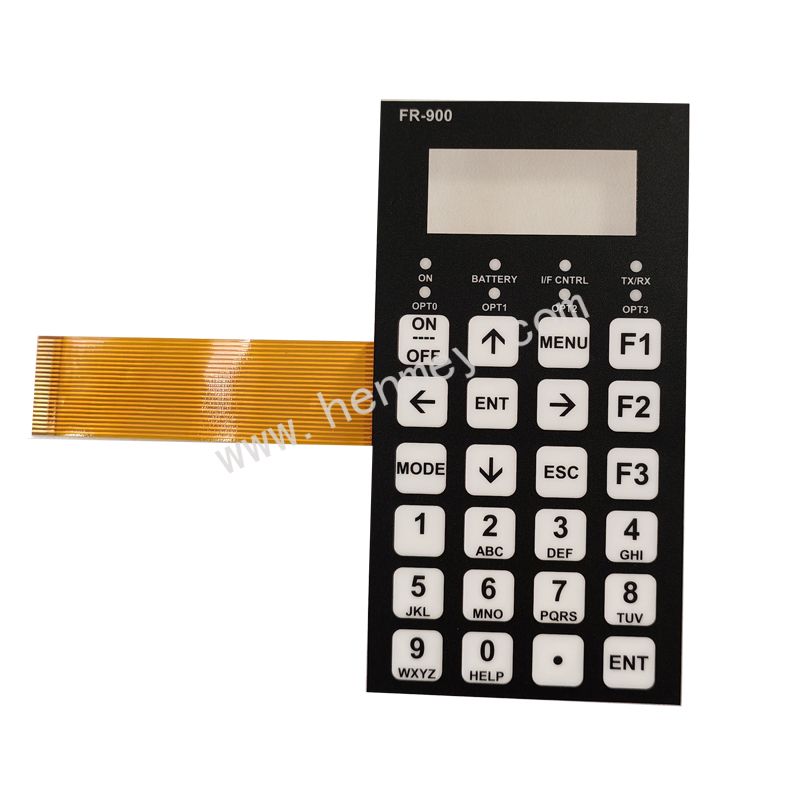

Membrane switch with FPC flexible circuit
A membrane switch with FPC combines a flexible printed circuit (FPC) with membrane keypads. It features flexible design, adapts to diverse requirements, and is widely used in scenarios such as instruments and meters, medical equipment, and industrial control panels.
Product Detail
Membrane switch construction:
A membrane switch consists of various layers laminated together. The layers of a basic membrane switch construction include: a membrane overlay, spacer, printer circuit, rear adhesive, and tail filler. Depending on the environment and requirements of the application into which the membrane switch plugs into, the construction can vary. For example, if shielding is necessary, a two-circuit membrane switch design would be a better construction choice.
For more stringent environmental requirements, the printed silver circuit can be replaced with a copper and polyimide construction. These construction designs offer advantage with regard to current carrying capacity and better resistance to moisture.
Electrical performance:
| Wire Resistance | 1.0mm width,<1Ω/cm | Rated Current | 25-150mA,0-30V DC |
| Insulation Resistance | >100MΩ 250V DC | Working Voltage | <50V DC |
| Non-tactile Switch Stroke | 0.1-0.4mm | Tactile Switch Stroke | 0.4-1.0mm |
| Working Life | >0.5-1.2 million times | Working Temperature | -20℃-40℃ |
| Working Humidity | 40℃,90%RH No Influence | Substrate Voltage | 1500V DC |
| Feed BackTime | 10ms | Tail Folding | R>1,180 angel |


 Copy product links
 Long by picture save/share
INQUIRY


Mobile: 0769 8307 8360
lE-mail: sales@henmey.com
Address: No 53. Chashan town, Dongguan city, Guangdong province, China.
© 2020 Henmey All rights reserved Site Map

点击右上角
分享给朋友吧
